Life Unmeasured: A New Year Without the Scorecard
I used to think there was something wrong with me.
I’ve never been good at keeping up with the streaks or the trackers or the endless self-improvement rituals everyone else seems to swear by. I don’t journal my profound observations every morning or log my mood, productivity, and habits to see if I’m “improving.”
I try. I dabble. I download the apps, open them a few times, and then quietly stop. Not out of rebellion. Just fatigue.
If I’m honest, I’ve never been interested in turning my life into a scorecard.
And standing at the beginning of another New Year, bracing for the tidal wave of New Year, New You messaging, I’ve finally realized something: the problem isn’t me.
My resistance to tracking and scoring isn’t a character flaw or a lack of discipline. It’s my human intuition.
The real problem is a system that teaches us to police ourselves for someone else’s profit and then frames the natural resistance and exhaustion that follows as a personal failure.
Once you see it, you can’t unsee it.
The relentless pressure to measure, track, and “improve” ourselves turns life into a performance, reducing our worth to metrics designed to be extracted and exploited.
We are not machines. We are soulful beings. We’re built for presence and dreaming and connection. Our lives were meant to be lived, not logged.
This is Part 1 of Life Unmeasured: a series exploring self-optimization culture and the cost of living under constant surveillance. Here, we’re offering a different conversation: one that values growth without metric obedience, and opens the door to a spectacular life without keeping score.
The Business of Bigger and Better
We live in a culture obsessed with metrics. Our worth is measured in steps, streaks, and side hustles. Everything is tracked. Everything is optimized. Everything is capitalized.
And we are entering the high season of the Optimization Industrial Complex. Over the next few weeks, millions of us will buy the rings, download the apps, and subscribe to the “blueprints” promised by longevity gurus. We’ll do it in pursuit of more mastery, more worth, and under the immense pressure of performance masquerading as inspiration blasted across social media.
Right now, the global self-improvement industry is valued at over $43 billion, with steady year-over-year growth. And the documented spike in anxiety isn’t incidental to that growth; it’s the product.
Let’s go ahead and name names. Apple profits every time you glance at your wrist to see if you “closed your rings.” Oura sells you a $300+ ring to tell you if your sleep was “good enough” (spoiler: it rarely is). And if the ring weren’t bad enough, Lumia just raised $7 million to launch smart earrings designed to track “hormonal health.” They are unabashedly asking us to adorn ourselves with surveillance, all so our biological rhythms can be monetized and sold back to us as “insight.” And be very certain of this: if your numbers aren’t exactly “right,” there will be tens of thousands of dollars’ worth of supplements, products, and procedures waiting so you can stay on the optimization treadmill.
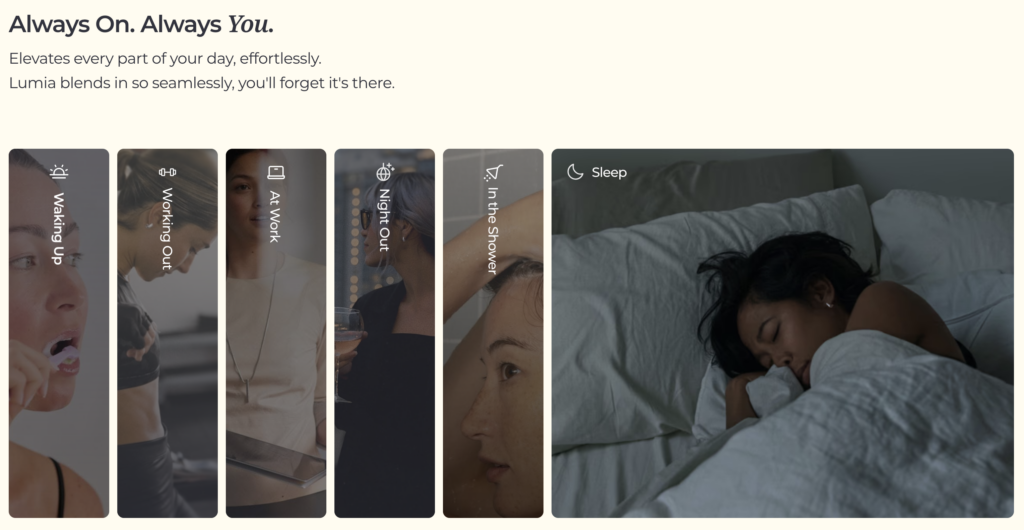
“Always On.” Lumia markets its smart earrings as effortless and invisible while collecting 24/7 behavioral and biometric data from morning through sleep. “Always you” quietly suggests that constant monitoring somehow captures your essence, as if identity can be reduced to what’s tracked, logged, and analyzed. The move is subtle but powerful and very dangerous: by collapsing selfhood into data, Lumia reframes surveillance as personal growth and trains users to internalize self-policing as authenticity, so opting out begins to feel like opting out of yourself
These companies aren’t selling health; they’re selling anxiety with a biometric interface.
If you’re not constantly building, scaling, or “manifesting” are you even living? Why does it feel like we constantly need to chase something to prove we’re worth something? A promotion. A six-pack. A side-hustle-turned-empire. A morning routine that rivals a billionaire’s.
A Caveat: Growth vs. The Machine
Before we go further, let’s be clear: This is not a plea to stop growing.
I believe in evolution and becoming a kinder, wiser, and more capable version of ourselves. But there is a massive difference between Soul-Led Growth and Machine-Fed Optimization. True growth comes from a place of love, intention, and a desire to be more present in your own life. Machine-led growth is about fear, performance, and running up your credit cards into oblivion to buy the latest gadget that promises to “fix” what was never broken.
Burnout Is Real. It's Not Your Fault.
Last year, a Vox journalist documented how health trackers unraveled his life. After six months of tracking every heartbeat, step, and glucose spike, he was anxious, compulsive, and disconnected from his joy. The data didn’t heal him. It haunted him. And I know we can all relate. When life becomes a spreadsheet, we stop living it.
There is extensive research showing that the platforms we use to “improve” ourselves are actively eroding our well-being. Heavy social media use is linked to higher rates of anxiety and depression. It ranks bodies, lifestyles, and happiness through likes and streaks, functioning as a real-time surveillance engine.
And a particularly sad part of the problem is that it’s not enough to do the extra work, or have the better body, raise happy children, or even meditate in the privacy of our own homes. There is the added pressure to orchestrate a whole lifestyle brand around our optimized lives. Then publish it for all to criticize and critique.
We were never meant to perform our lives this way.
You Are Not A Machine
Somewhere along the way, being human became a data point. But humans were never meant to function like machines, no matter how profitable that idea has become.
Here’s what nobody talks about when they’re selling you the latest tracking device: the opportunity cost.
What are you missing while you’re busy measuring? I’m not talking about the time spent logging data…though that adds up. I’m talking about the moments that slip away because you’re so focused on optimizing them:
- The spontaneous road trip you didn’t take because it would mess up your meal prep schedule.
- The lazy Sunday morning you couldn’t enjoy because your sleep score was “poor” and you spent two hours researching how to fix it.
- The hobby you used to love that became another metric to track, another thing to monetize, another source of pressure instead of pleasure.
- The dinner with friends where you were mentally calculating macros instead of actually tasting the food or enjoying the conversation.
- Fill in the ____.
This is the invisible tax of constant surveillance: We optimize our way out of joy.
Right now, we’re tracking ourselves into paralysis, and it just keeps getting worse. We’re measuring moments that were meant to be felt, not quantified. And we are blindly letting others make billions off the insecurities that are grown from the scorekeeping economy.
And if we don’t step out of this cycle? The cost is enormous.
- We become strangers to ourselves. We forget what we actually like versus what we think we should like.
- We lose trust in ourselves. We don’t trust our own bodies, our own instincts, our own sense of what feels good.
- We outsource our intuition. We become so dependent on external validation that we can’t tell anymore if we’re genuinely happy or if we just hit our metrics for the day.
- We teach our kids their worth is quantifiable. We pass this anxiety down to our kids.
Let's Break Free
What if we reframed everything? You don’t have to monetize your hobbies, master your morning or build a brand. You 100% don’t need a 20 step skincare routine to be amazing and loved.
Living your life without analysis or measurement is a kind of freedom we rarely talk about but desperately need.
Think about the people who came before all this madness. Your grandmother, your great-aunt, that neighbor who lived to 95 and never owned a fitness tracker. They didn’t know their VO2 max. They never counted steps or tracked sleep cycles. They didn’t photograph every meal or worry about their “personal brand.” And you know what? They lived full, rich lives. They had deep friendships, made memories, fell in love, raised families, pursued passions, experienced joy, all without a single app telling them if they were doing it right. They trusted their bodies to tell them when they were tired, when they were hungry, when they needed to move or rest.
Imagine that: trusting yourself without needing a device to confirm your experience is valid.
Have you ever watched nature in awe of how perfectly optimized it is? In the rest of the animal kingdom, nobody is tracking anything. Birds aren’t tracking their flight mileage, owls don’t track sleep cycles and wolves don’t rate their pack performance at the end of each season. The rest of the animal kingdom just is — alive, instinctual, present.
They don’t need spreadsheets or habit stacks to justify their existence.
Yes, yes, of course, we are far more complex than birds and wolves. We have the advantages of abstract thought, complex language, cultural development, and the capacity for self-awareness and morality (well most of us do).
But there’s a lesson in it all: existing is inherently optimized. Brilliant. Magical. Unmeasured.
Thriving doesn’t have to mean hustling. Sometimes it means waking up, stretching in the sun, and living your damn life.
So if today you didn’t build a brand, change the world, or tick off a single item on your list, you still did enough. Living your life free, and fully human, is worthy of praise.
Your Turn For 2026 - Freedom
Ready to take one small step toward unmeasured living right now?
Pick one thing you’re currently tracking and stop. Just stop. Delete the app. Take off the ring. Stop logging your food, your steps, your productivity.
Choose the one thing that makes you feel the most anxious or inadequate, and let it go.
If that feels too scary, start smaller: Take one day this week where you don’t check any of your metrics. No sleep score. No screen time report. Wake up and skip the optimized morning routine you were told you need. Just live the day and see how it feels to move through the world without a performance review.
You don’t need to announce it. You don’t need to make it a whole thing. You don’t even need to stick with it forever. Just try it.
Give yourself the gift of one unmeasured moment, one unmeasured day, one unmeasured week, and notice what comes back to you when you’re not busy keeping score.
This is Part 1 of the Life Unmeasured series. In Part 2, we’ll dive deeper into practical strategies for opting out of the optimization cult and building a life that’s measured in meaning, not metrics. Until then: breathe. Be. You’re already enough.